
By Marty Schladen
Ohio Capital Journal
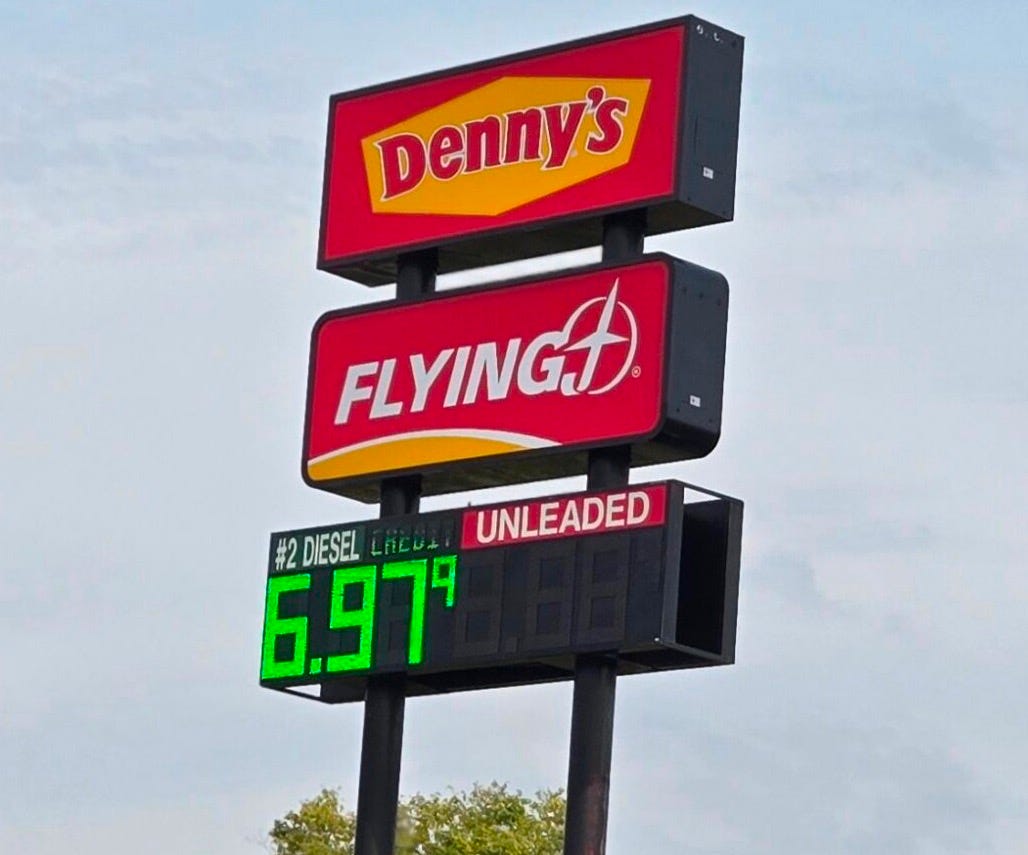
COLUMBUS — When truck stops and gas stations erected their signs, they didn’t anticipate needing two digits before the decimal point. But an Ohio-based data analyst who used to work in the energy industry says it’s a distinct possibility that they’ll need to find one for diesel.
As President Donald Trump’s war with Iran has continued, the rising cost of diesel fuel has been felt by all consumers, even if they don’t buy diesel fuel at the pump.
That’s because 96.8% of commercial semi-trucks, nearly all U.S. freight trains, and virtually all cargo shipsare powered by diesel or its distillate cousin, fuel oil. Jet fuel, too, is a “middle distillate,” and competes with diesel and fuel oil for refinery output.
So nearly all the food and consumer goods that Ohioans buy traveled most of the way to their house on the power of diesel or a related fuel.
In Ohio on Sept. 22, diesel hit its highest average price on record — $6.80 a gallon, according to the American Automobile Association.
Those prices appear to be getting more volatile and heading generally upward at a time when diesel prices are already playing a big role in the affordability crisis that’s plaguing millions of Americans, said Dayton-based data analyst Eric Pachman.
He built a data visualization showing that as diesel goes up, so does the fuel surcharge for everything consumers buy.
In September 2025, the surcharge was 11% to 14%, depending on whether goods are shipped by truck or rail. By this September it was 21% to 27%.
If diesel goes to $10 a gallon, the fuel surcharge will be 30% to 37%, according to Pachman’s model.
He now runs the nonprofit Data 4 the People, which seeks to use high-level analysis to inform journalism and public policy. He previously held senior roles doing data analysis, modeling and engineering in a number of fields, including energy, transportation and finance.
According to another data visualization Pachman built, diesel reserves are the lowest they’ve been for this time of year at least since 1980.
That, Pachman explained, makes the entire system vulnerable to all kinds of potential problems.
One is that global demand for U.S.-produced diesel shot up because of supply disruptions caused by the war with Iran.
Refineries are highly complex facilities and they periodically shut down to do scheduled maintenance in a process called “turnaround” that typically takes place in the spring or fall.
Now, with global demand so high, refineries are delaying their turnarounds to take advantage of the huge profits that are available, Pachman said.
“They’re saying, ‘We’ll take our chances,’” he said. “And guess what just happened? A refinery broke down and it was one in the Midwest. When you saw a big jump in diesel prices, it was because of that. This is going on everywhere. You’re laying one risk on top of the next risk on top of the next risk.”
He was referring to the ExxonMobile refinery in Joliet, Ill., that went offline Sept. 13 and took weeks to restart. According to the U.S. Energy Information Agency, diesel prices in the Midwest jumped from $6.25 a gallon on Sept. 14 to $6.68 a week later.
Pachman said refineries are running full bore and reserves are at an all-time low at exactly the wrong time of year — heading into winter. Particularly in the Northeast, fuel oil is widely used for heating, and demand for it will go up as temperatures go down.
“If we use more heating oil we have less diesel and that’s why refineries try to stock up, and you can clearly see from this chart going into the winter,” he said, referring to his reserve visualization. “Week 38 (of 2026) is where we try to peak out on our inventories and drop down from there.”
As the stresses in the system grow, it becomes more volatile, making progressively crazier outcomes more likely, Pachman said.
“The reason I think $10 is a distinct possibility is because things don’t move linearly,” he said. “At a certain point, people just freak out about stuff. We haven’t reached that point. Things have gradually risen as supply has drained to the lowest levels on record. There’s been no freakout yet. But I’d say it’s a distinct possibility or even a reasonable probability.”
As for finding a way to post such prices on truck-stops’ signs, Fortune on Sept. 10, reported that in California, they hadn’t. The story was titled “$9.999 and maxed out: California diesel prices overwhelm pump displays as global supply crunch worsens.”
Diesel retailers Marathon Oil, Pilot Travel Centers and BP were asked if they thought diesel could go to $10 in Ohio, and whether they planned to adjust their signs if it did. None responded.

With no resolution of the war in sight, measures have been proposed to ease the pain at U.S. truck stops. Neither effectively addresses the underlying problem, Pachman said.
Ohio last week suspended the 47-cent-a-gallon diesel tax until Jan. 2. That means the state will lose about $725 million from gasoline and diesel taxes.
It’s money that builds and maintains roads, bridges and waterways. The state will replace any funds local governments might lose, but that’s still public money that won’t be available for any other purpose.
That’s happening as more than 500,000 Ohioans are expected to lose health coverage due to changes at the federal level. More than 100,000 Ohioans had already lost federal food assistance by July as a consequence of Trump’s One Big Beautiful Bill Act.
Pachman said the fuel tax holiday also warps the proper functioning of the marketplace.
When goods become scarce, they get more expensive, and that motivates people to use less, find alternatives, or both. When the Ohio legislature artificially made diesel 47 cents cheaper, it short-circuited part of that dynamic, Pachman said.
Partly due to its refining capacity, the U.S. is the largest diesel exporter in the world. Present circumstances make that a problem.
“The war screwed all that up,” Pachman said. “Not only do we not have enough for us, we’re also still exporting it.”
Some farm-state lawmakers are still pushing an export ban on diesel even after Trump said he wouldn’t support one. Pachman said such a ban is a lot more complicated than it might sound.
“On the surface it might sound like a good idea,” he said. “But it could make everything worse because it could create such a global shortage that in Europe it could shoot prices through the roof and create chaos and raise prices here because we’re all linked.”
There are reasons to believe that even without a ban, diesel won’t go to $10 a gallon in the Buckeye State. But one would be bitter medicine if it happens.
Escalating global debt — due partly to spiking energy costs — is creating volatility in the bond markets. And worries are growing that the entire economy is propped up by a tech bubble that’s about to burst.
If the economy tanks due to those dynamics, diesel probably won’t reach $10, Pachman said. But it isn’t something to look forward to.
“One reason I think it might not happen is you may destroy demand,” he said. “At a certain point in time, people may stop buying because it’s too expensive.”
He added, “But that’s not a reason to celebrate — if we go into another Great Recession.”