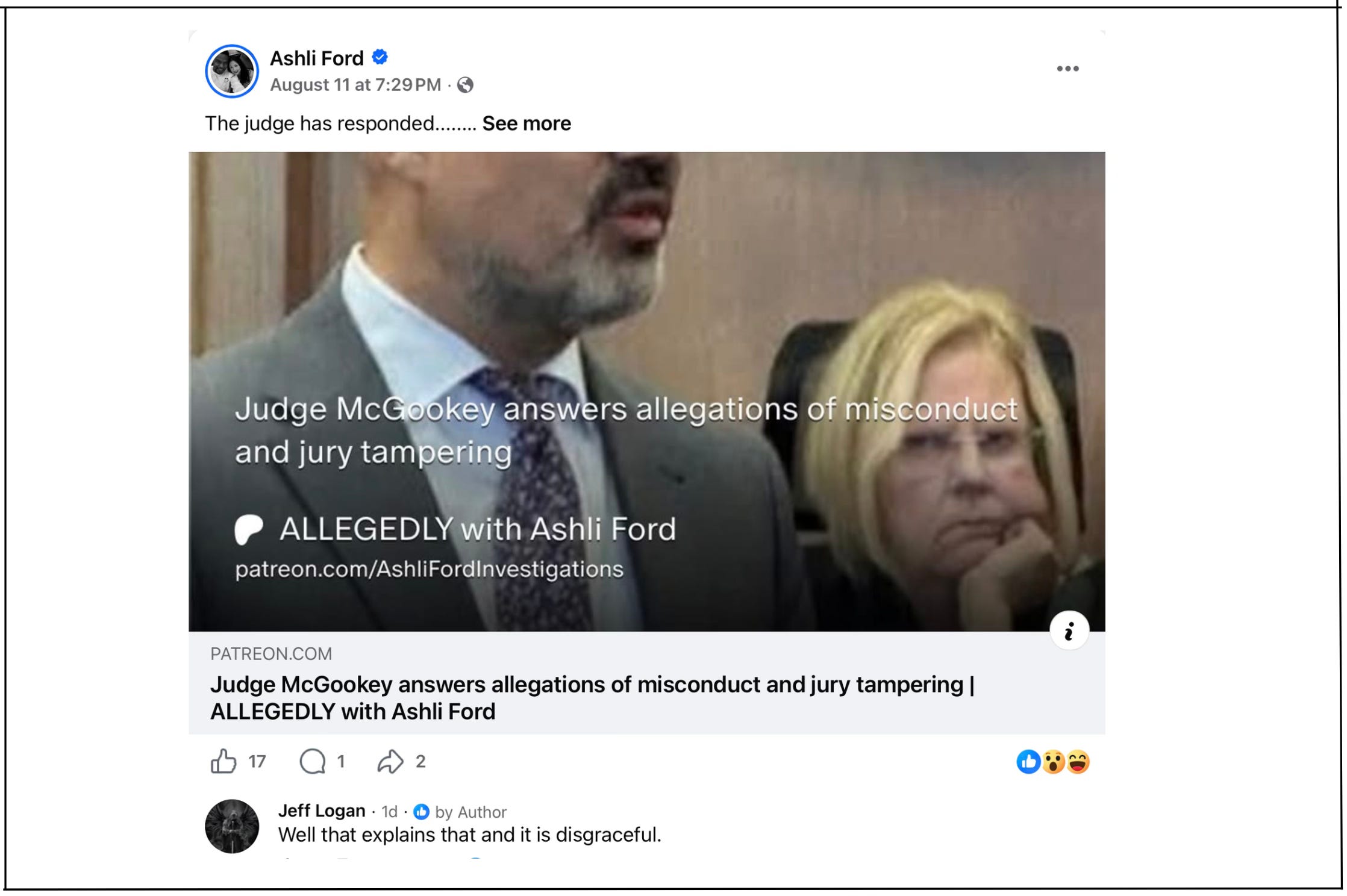
SANDUSKY — Virtually no competent criminal defense attorney would recommend or approve the kind of commentary convicted podcaster Ashli Ford used this week in a social media post promoting her paid site, according to a legal analysis of the post.
Using a copyrighted photo owned by StayTunedSandusky.com without permission, Ford, who is charged with perjury stemming from her testimony at her May trial, effectively called Erie County Common Pleas Judge Beverly McGookey and prosecutors liars.
“The evidence and admissions by the judge strongly indicated that the judge and prosecutor have lied to the Supreme Court in a sworn filing,” Ford wrote, calling McGookey’s response to her defense counsel’s Affidavit for Disqualification “rambling” and “embarrassing to the court as a whole.”
“It is certainly indicative of why judges are forced to retire from the bench at her age,” Ford added.
Ford and her attorney contend that McGookey, Prosecutor Kevin Baxter, law enforcement officers, and state witnesses are all conspiring against her and lying about an alleged banking scheme that netted her $150,000.
Her May trial ended in a hung jury, and Ford is scheduled for a retrial next month. Prosecutors accuse Ford of scamming $30,000 in COVID relief funds using her ex-husband’s credit, lying about his income, pretending she was still married to him, and forging loan documents to secure a $120,000 mortgage modification three years after their separation.
She was indicted on a perjury charge after her May trial. Prosecutors contend she lied about a prominent local man being a key witness who could vouch for her. Listen to the alleged perjured testimony here:
Where’s Uncle Gene
Trial by social media
Ford’s methods are a textbook example of a defendant using public platforms like Substack, Patreon, and Facebook to air detailed grievances, allege judicial misconduct, and publicly criticize a presiding judge. Without the burden of legal proof or documentation required in a courtroom, the strategy relies on unvetted public accusations.
An analysis of Ford’s article and social media presentation evaluated whether a competent attorney would advise a client to publish such material while cases remain pending.
While taking to social media may feel cathartic or offer a sense of control, legal consensus holds that publishing this type of commentary carries immense risk with virtually zero upside in a court of law. Defense counsel typically advises strongly against publishing posts of this nature for several critical reasons:
Gag Order Violations and Contempt Risks: In her post, Ford references past and present gag orders. Publishing detailed commentary, evidentiary arguments, and accusations online while subject to active court orders creates immediate legal peril. If a court finds that public posts breach a protective or gag order, the defendant faces direct contempt of court—leading to fines, bond revocation, or immediate incarceration before the case is even tried.
Court of Public Opinion vs. Court of Law: Allegations of judicial misconduct—such as improper ex parte communications, jury tampering, or sworn misrepresentations to the Ohio Supreme Court—are grave matters. However, public opinion carries no weight in appellate or Supreme Court reviews. Judicial outcomes depend strictly on the official record and formal filings. Litigating on Substack or Patreon risks signaling to higher courts a preference for public spectacle over legal procedure.
Creating Adverse Evidence: Anything a defendant writes publicly can be used against them; blog posts are not protected by attorney-client privilege. Prosecutors can analyze public commentary for inconsistencies to impeach credibility, treat casual statements as legal admissions, or use public perjury accusations on monetized platforms (like Patreon) as grounds for civil defamation or additional criminal charges.
Prejudicing Proceedings and Alienating the Court: Launching personal broadsides—such as attacking a judge’s age or competence—creates hostility. Attacking a judge during active litigation rarely yields a favorable outcome, alienates the bench, and complicates working relationships between counsel and the court.
While the First Amendment protects a citizen’s right to criticize public officials, exercising that right during active legal proceedings is counterproductive to a criminal defense. Competent counsel routinely advises clients to remain silent publicly and let their legal team fight inside the courtroom.
Conclusion
Continue reading this post for free, courtesy of Matt Westerhold.