Holy Ethical Dilemma: What ‘20/20’ missed about Ashli Ford
Network left out her trail of felony convictions, upcoming fraud trial, and allegations of victim exploitation from Friday broadcast
MILAN, Ohio — On Friday night, millions of viewers tuned into ABC’s 20/20 to watch “The Secret in the Water.” They were introduced to Ashli Ford, a local podcaster portrayed as a tenacious seeker of justice who helped crack the 2001 homicide of Regina Rowe Hicks.
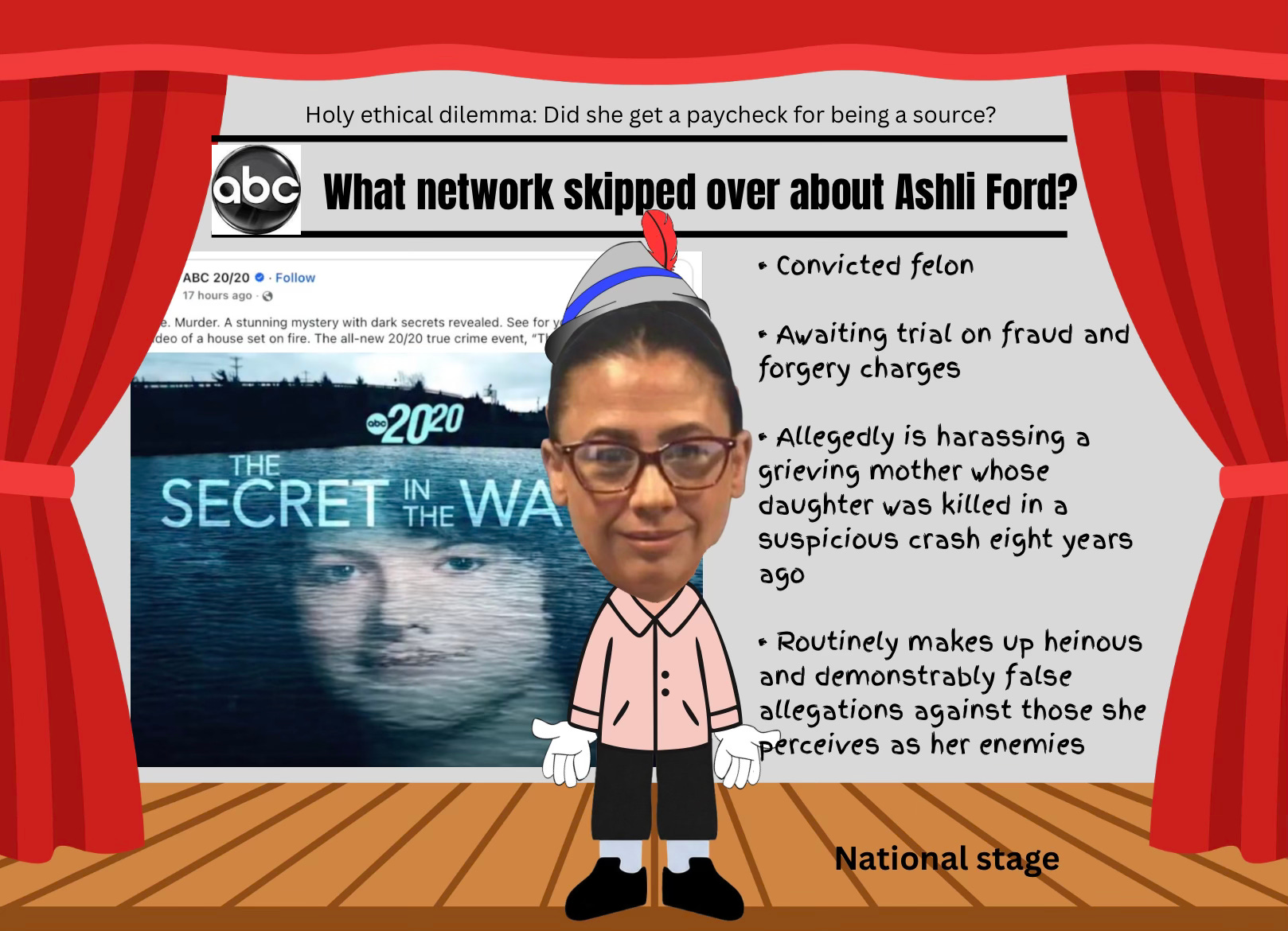
But for those who live in the communities Ford covers, the four-minute segment felt less like journalism and more like an editorial failure.
While correspondent Deborah Roberts allowed Ford to take a victory lap on a national stage, the network remained silent on a crucial detail: the “investigator” they were spotlighting is a convicted felon whose specialty, according to prosecutors, isn’t justice—it’s intimidation.
Vetting gap
The most glaring omission in the broadcast was Ford’s criminal history. ABC failed to mention that just last year, Ford was convicted on four felony counts of intimidation. These were not abstract crimes; they were directly related to her conduct as a self-described “journalist” and “advocate” using social media to threaten public officials.
The network also skipped over the fact that Ford is due in Erie County Common Pleas Court in just two weeks to face a new set of felony charges for fraud and forgery.
‘Clickbait’ vs. credibility
The 20/20 segment framed Ford as a catalyst for the Hicks case, but local investigators and victim families tell a different story.
Prosecutors have characterized Ford’s claims of “solving” cases as bogus, alleging she exploits grieving families as clickbait to generate social media revenue. This sentiment was echoed by Caroline Tokar, the mother of murder victim Amanda Dean.
Following the broadcast, Tokar pointedly ignored Ford’s claims of solving her daughter’s case, instead showing gratitude to the state investigators who actually secured a conviction. “Thank you for all the hard work investigating and conviction on my daughter Amanda Dean case,” Tokar wrote, crediting the professionals over the podcaster.
Pay-to-play?
Perhaps the most troubling allegation surfaced a few weeks ago, before Friday’s segment aired. Ford reportedly told the Sandusky Register that she was hired by ABC News as a “field producer“ and paid $2,800.
If true, this represents a staggering breach of journalistic ethics. Standard industry practice strictly prohibits paying the subject of a news story, as it incentivizes biased or sensationalized testimony. When asked about this potential “pay-to-play” arrangement and their vetting process, ABC News producers have thus far remained silent.

Real cost of fame
Beyond the courtroom and the editing bay, there is a human cost. Ford has been credibly accused of using her platform to dox private citizens, harass grieving mothers, and even falsely accuse a judge of participating in a “sex ring”—all without offering a shred of evidence.
By granting Ford “four minutes of fame” without providing the context of her criminal background, ABC News didn’t just miss the story. They may have emboldened a pattern of digital hostility that the region has been dealing with for years.
The Regina Hicks case was a tragedy solved by diligent police work and a persistent prosecution. Whether Ashli Ford was a help or a hindrance is a question 20/20 should have asked before they hit “record.”


